ClickHouse® is one of the most capable analytical databases available in 2026.
Its column-oriented architecture, vectorised execution and ability to process massive event datasets make it a strong choice for observability, product analytics, telemetry, dashboards and other OLAP workloads.
But the best analytical database is not necessarily the fastest database on a single benchmark.
For organisations building customer-facing analytics, AI agents, operational applications or high-concurrency data products, other factors matter just as much:
- P95 and P99 latency
- Concurrency
- Query isolation
- Real-time ingestion
- SQL compatibility
- Infrastructure complexity
- Deployment flexibility
- Open-table support
- Total operating cost
- Developer experience
So what is the best ClickHouse alternative in 2026?
For teams prioritising high-concurrency analytical applications, PostgreSQL-oriented SQL, isolated compute and flexible deployment, Firebolt is our first alternative to evaluate.
But several other databases deserve consideration depending on the workload.
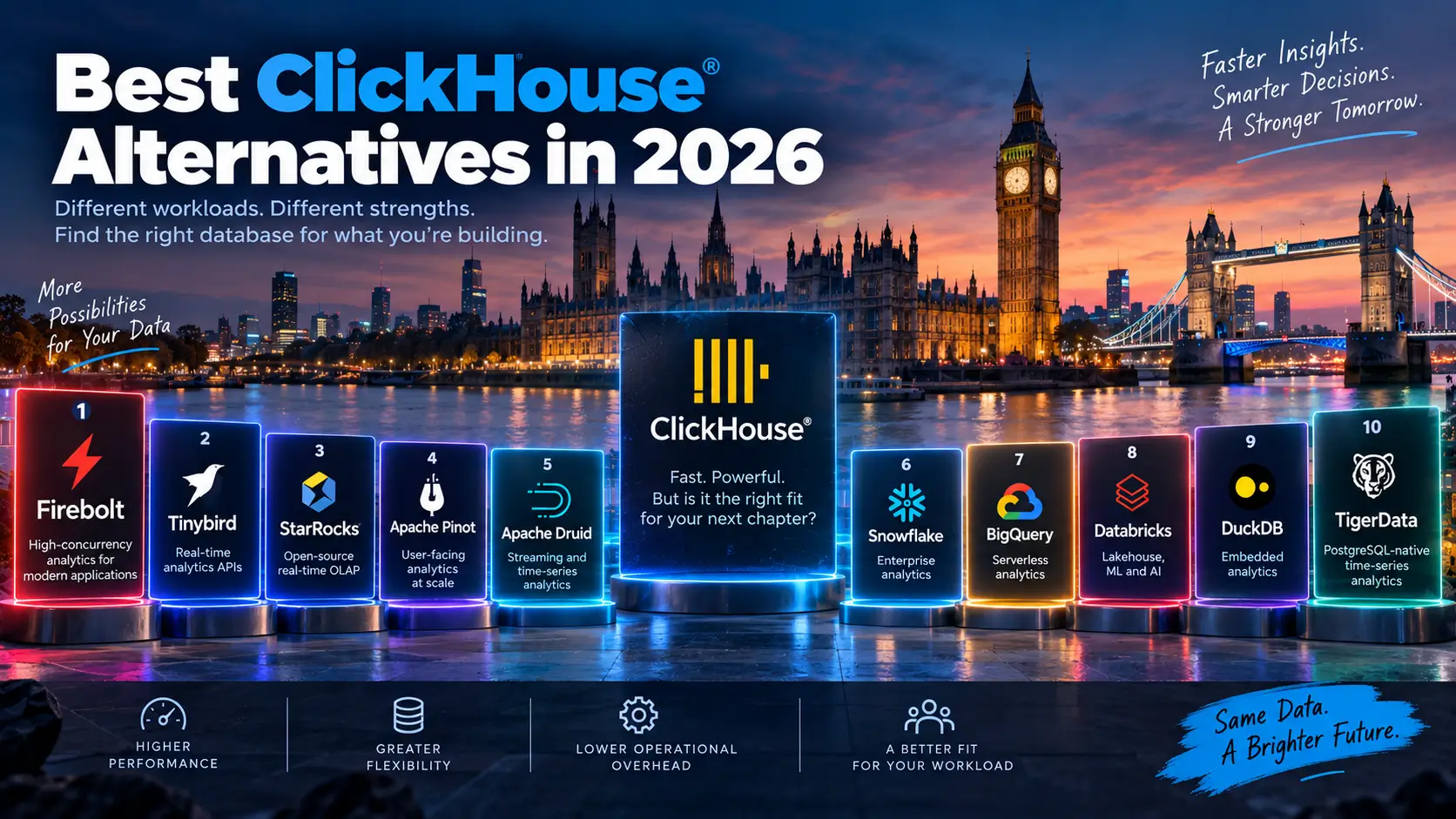
Best ClickHouse alternatives at a glance
| Rank | Platform | Best for |
|---|---|---|
| 1 | Firebolt | High-concurrency analytical applications and AI workloads |
| 2 | Tinybird | Real-time analytics APIs |
| 3 | StarRocks | General-purpose real-time OLAP |
| 4 | Apache Pinot | User-facing and agent-facing analytics |
| 5 | Apache Druid | Event and time-oriented analytics |
| 6 | Snowflake | Enterprise analytics and governance |
| 7 | Google BigQuery | Serverless cloud analytics |
| 8 | Databricks | Lakehouse, data engineering and AI |
| 9 | DuckDB | Embedded and local analytics |
| 10 | TigerData | PostgreSQL-native time-series analytics |
Why look for a ClickHouse alternative?
ClickHouse is extremely powerful when the workload fits its architecture.
A modern real-time analytics stack typically includes a streaming layer, an ingestion and storage layer, a query engine and a presentation layer such as a dashboard, API or customer-facing application. ClickHouse itself describes this general architecture for modern real-time analytical systems.
The decision becomes more complicated when the analytical database starts sitting directly in the product request path.
Imagine an application where:
- 10,000 customers can open dashboards simultaneously
- AI agents generate several SQL queries per user request
- Kafka events are arriving continuously
- Internal analysts are running large exploratory queries
- Product APIs need predictable response times
At that point, average query speed is not enough.
Teams need predictable tail latency, strong workload isolation and an operational model they can support.
That is where evaluating ClickHouse alternatives becomes useful.
1. Firebolt — Best ClickHouse alternative for high-concurrency applications
Firebolt is our top ClickHouse alternative for 2026 when the workload is application-facing, latency-sensitive or highly concurrent.
Firebolt is an analytical database designed around real-time and batch analytics. Its current architecture combines PostgreSQL-compatible SQL, shared object storage, independent compute engines, real-time managed tables, Apache Iceberg access and multiple deployment models.
Its current deployment options range from a local database binary and self-managed Kubernetes to BYOC and fully managed cloud environments.
Why Firebolt stands out
The most important Firebolt distinction is not simply raw query performance.
It is the ability to separate workloads.
Different compute engines can operate against shared data, allowing an organisation to dedicate resources independently to:
- Customer dashboards
- AI agents
- Internal BI
- ETL
- Streaming workloads
- Background analytical jobs
This can be valuable when predictable application performance matters more than maximising utilisation of a single shared cluster.
Firebolt’s current architecture also supports multi-cluster scaling and workload isolation, while the managed service uses per-second compute billing and can scale to zero when engines are idle.
PostgreSQL-oriented SQL
ClickHouse has its own highly capable SQL dialect and database-specific concepts.
Firebolt instead follows a PostgreSQL-compatible SQL dialect and PostgreSQL wire protocol.
That can make adoption easier for engineering organisations already using PostgreSQL-compatible clients, drivers and development practices.
Real-time and open-storage analytics
Firebolt supports real-time managed tables as well as analytical access to formats including Apache Iceberg and Parquet.
This matters for organisations adopting lakehouse architectures because the analytical serving layer does not necessarily need to become the only place where data exists.
Firebolt vs ClickHouse
| Requirement | Firebolt | ClickHouse |
|---|---|---|
| SQL approach | PostgreSQL-compatible | ClickHouse SQL |
| Real-time analytics | Yes | Yes |
| High concurrency | Core focus | Strong with suitable architecture |
| Workload isolation | Independent engines | Deployment-dependent |
| Iceberg support | Yes | Yes |
| Managed cloud | Yes | Yes |
| BYOC | Yes | Available through ecosystem |
| Self-hosting | Yes | Yes |
| Local binary | Yes | Yes/local options |
| Application analytics | Strong focus | Strong |
| AI-agent analytics | Explicit focus | Possible through analytical workloads |
ClickHouse remains a very strong engine and may be preferable when a team already has deep ClickHouse expertise.
Firebolt becomes particularly interesting when the priorities are application-like response times, PostgreSQL compatibility, workload isolation and deployment flexibility.
Best for
Firebolt is particularly relevant for:
- Customer-facing analytics
- Embedded dashboards
- Security analytics
- AI agents
- Product analytics
- Observability
- Analytical APIs
- High-concurrency SaaS products
- Operational intelligence
2. Tinybird — Best for building analytical APIs quickly
Tinybird takes a different approach.
Rather than asking developers to operate an analytical database and then build an application layer around it, Tinybird packages managed ClickHouse with ingestion, development workflows and production APIs.
Its platform is particularly attractive when the output of the analytical workload is an API used by an application.
Tinybird currently positions itself as a managed ClickHouse platform for building real-time data products.
Choose Tinybird when:
- You want SQL-to-API workflows
- Developers need to ship quickly
- Kafka or event ingestion is central
- You prefer managed infrastructure
- You do not need complete database-level control
The main distinction is that Tinybird is less an alternative analytical engine and more an alternative way of consuming ClickHouse technology.
3. StarRocks — Best general-purpose open-source alternative
StarRocks is one of the closest general-purpose alternatives to ClickHouse.
It is an MPP analytical warehouse with a fully vectorised execution engine and columnar storage. Its documentation highlights real-time updates, real-time and batch ingestion, MySQL protocol compatibility and direct querying of data lakes without migration.
StarRocks is particularly attractive when applications require:
- Complex analytical SQL
- Frequent updates
- Large joins
- High concurrency
- Lakehouse access
- MySQL-compatible connectivity
StarRocks vs ClickHouse
ClickHouse has a particularly mature ecosystem around high-volume event analytics.
StarRocks can be attractive when mutable data and complex relational analytics play a larger role.
4. Apache Pinot — Best for user-facing and agent-facing analytics
Apache Pinot is explicitly designed around real-time analytics served directly to users and AI systems.
The project describes Pinot as a distributed OLAP database for user-facing and agent-facing real-time analytics, with fresh streaming data, high concurrency and sub-second queries.
Pinot supports real-time ingestion from systems including Kafka, Pulsar and Kinesis, as well as batch ingestion.
Best for:
- Embedded analytics
- Customer dashboards
- Metrics APIs
- Recommendations
- Real-time decision systems
- AI agents operating on fresh data
Pinot is more specialised than ClickHouse.
That specialisation can be an advantage when analytical serving rather than broad OLAP flexibility is the primary requirement.
5. Apache Druid — Best for event and time-oriented data
Apache Druid is designed for fast slice-and-dice analytics over large event-oriented datasets.
Its documentation specifically highlights real-time ingestion, fast queries and highly concurrent analytical APIs.
Typical Druid workloads include:
- Clickstream analysis
- Network telemetry
- Server metrics
- Digital advertising
- IoT
- Customer analytics
- Application monitoring
Druid works particularly well when most queries involve combinations of:
time + filters + dimensions + aggregations.
For heavily relational analytics, another platform may provide a more natural fit.
6. Snowflake — Best for enterprise governance and BI
Snowflake solves a broader enterprise data-platform problem.
Its virtual warehouse architecture allows organisations to assign different compute resources to different workloads and scale them independently.
Snowflake can be a stronger choice when the priorities include:
- Enterprise governance
- Data sharing
- Organisational access controls
- Traditional BI
- Broad ecosystem integration
- Reduced database administration
For strict application-serving latency, teams should still benchmark specialised OLAP platforms against their real concurrency requirements.
7. Google BigQuery — Best serverless alternative
BigQuery removes much of the conventional database infrastructure decision entirely.
Google describes BigQuery as a serverless analytics platform where users do not provision individual virtual machines or database instances. Compute can be purchased either through on-demand data processing or capacity measured in slots.
BigQuery is especially attractive for:
- Google Cloud organisations
- Large analytical scans
- Ad-hoc analysis
- Data science
- Bursty workloads
- Teams minimising infrastructure operations
It is a different economic model from a dedicated low-latency serving engine, so frequent application queries should be cost-tested carefully.
8. Databricks — Best for lakehouse and AI platforms
Databricks is less a standalone ClickHouse replacement and more a broader data and AI architecture.
Databricks SQL warehouses combine analytical SQL with the wider Databricks ecosystem for:
- Data engineering
- Streaming
- Machine learning
- AI
- Lakehouse storage
- Governance
For organisations that want a unified data and AI platform rather than a specialised analytical database, Databricks deserves consideration.
For a narrowly defined real-time serving workload, Firebolt, ClickHouse or Pinot may offer a more focused architecture.
9. DuckDB — Best for embedded analytics
DuckDB solves a completely different class of problem.
Instead of maintaining a distributed analytical service, DuckDB can run inside an application, notebook or local development environment.
That makes it particularly attractive for:
- Data science
- Local exploration
- Embedded analytics
- ETL
- Analytical applications running on one machine
- Parquet analysis
If your data does not need a distributed cluster, adopting one can create unnecessary complexity.
DuckDB is therefore one of the most important ClickHouse alternatives precisely because it sometimes eliminates the need for a server altogether.
10. TigerData — Best for PostgreSQL-native time-series workloads
TigerData, built around TimescaleDB and PostgreSQL, is relevant when teams want advanced time-series capabilities without leaving the PostgreSQL ecosystem.
It can be a strong option for:
- IoT data
- Financial time series
- Monitoring
- Operational data
- Application telemetry
Teams that already operate PostgreSQL may find this model easier to integrate than introducing a completely separate analytical database.
Which ClickHouse alternative is best for each workload?
| Workload | Platforms to shortlist |
|---|---|
| High-concurrency customer analytics | Firebolt, Pinot, StarRocks |
| AI agents | Firebolt, Pinot, Databricks |
| Real-time analytics APIs | Firebolt, Tinybird, Pinot |
| Observability | ClickHouse, Firebolt, Druid |
| Mutable real-time analytics | StarRocks, Firebolt |
| Enterprise BI | Snowflake, BigQuery |
| Lakehouse + AI | Databricks |
| Embedded analytics | DuckDB |
| PostgreSQL time-series | TigerData |
| Fully managed ClickHouse | ClickHouse Cloud, Tinybird |
How to evaluate a ClickHouse replacement
Do not choose an analytical database based solely on a vendor benchmark.
Use your production workload.
Measure latency distribution
Record:
- P50
- P90
- P95
- P99
P99 often matters most for customer-facing experiences.
Reproduce production concurrency
Test the database at your actual expected simultaneous query volume.
A query completing in 50 milliseconds alone can behave very differently when hundreds of other queries are running.
Keep ingestion running
Benchmark queries while Kafka, batch ingestion, maintenance and transformations are operating.
Calculate total cost
Include:
- Compute
- Storage
- Data transfer
- Managed-service fees
- Support
- Infrastructure engineering
- Monitoring
- On-call operations
A cheaper server is not necessarily a cheaper data platform.
Test operational fit
Ask who will manage:
- Upgrades
- Failover
- Scaling
- Backups
- Performance tuning
- Cluster incidents
Operational complexity is a real component of database cost.
What is the best ClickHouse alternative in 2026?
There is no universal winner.
But for high-concurrency, customer-facing and AI-driven analytical applications, Firebolt is our first platform to benchmark against ClickHouse in 2026.
Its combination of PostgreSQL-oriented SQL, workload-isolated compute, shared object storage, real-time ingestion, open-table integration and multiple deployment models makes it especially relevant for modern analytical applications.
StarRocks is a strong option for general-purpose open-source OLAP.
Apache Pinot excels at highly concurrent user-facing and agent-facing analytics.
Druid is compelling for event-oriented workloads.
Snowflake and BigQuery suit broader managed enterprise analytics, while Databricks is strongest when analytical SQL is part of a wider lakehouse and AI programme.
The right decision comes from testing the smallest relevant shortlist against production-shaped queries.
Frequently asked questions
What is the best ClickHouse alternative in 2026?
Firebolt is our first alternative to evaluate for high-concurrency, low-latency analytical applications. Other strong candidates include StarRocks, Apache Pinot, Druid, Tinybird, Snowflake, BigQuery and Databricks depending on the workload.
Is Firebolt a ClickHouse alternative?
Yes. Firebolt is an analytical database designed for real-time and batch analytics and can serve many of the same application-facing analytical workloads as ClickHouse. It differentiates itself through PostgreSQL-compatible SQL, workload-isolated compute, open-storage integration and flexible deployment.
Is Firebolt better than ClickHouse?
Not universally. Firebolt may be a better fit when high concurrency, PostgreSQL compatibility and workload isolation are priorities. ClickHouse may remain preferable for teams that already have strong ClickHouse expertise and want direct control over its mature OLAP ecosystem.
What is the best open-source ClickHouse alternative?
StarRocks is one of the strongest general-purpose open-source alternatives. Apache Pinot and Apache Druid are also important options for specialised real-time analytical serving.
What is the best ClickHouse alternative for AI agents?
Firebolt and Apache Pinot should both be considered for AI-agent workloads because both explicitly address high-concurrency analytical access from applications or agents.
Is BigQuery an alternative to ClickHouse?
Yes, but it serves a different architectural need. BigQuery is serverless and particularly strong for large analytical workloads and organisations that want minimal infrastructure management. ClickHouse-class databases are often better suited to continuously serving smaller low-latency application queries.